
< Arabic 1477: al : the, za'uq : mercury > In alchemy, the Mercury, the first principle of all the metals.
(The New Century Dictionary, 1957.)
 |
 |
|
|
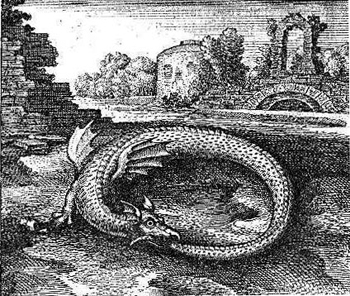
Hic est Draco caudam suam devorans. ("Here is the Dragon that bites its own tail...") from Atalanta Fugiens Michael Maier, Prague, 1618 |
|
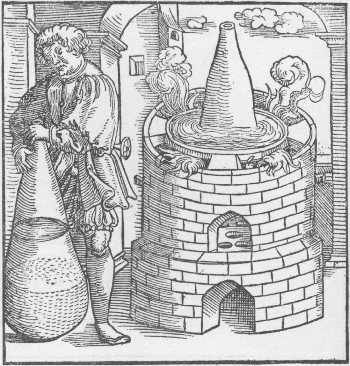
Waterbath (le bain-Marie) from De re metallica (1557) Georgius Agricola 1494-1555 (Georg Bauer) Chemnitz, Electorate of Saxony |
(The Oxford Universal Dictionary, 1933, 1955.)
A medieval speculatve science and philosophy aiming to achieve the transmutation of base metals into gold, the discovery of a universal cure for disease, and a means to indefinately prolong life.
(Mirriam Webster's Collegiate Dictionary, Tenth Edition, 1995.)
The Universal Medicine is, for the soul, supreme reason and absolute justice; for the mind, it is mathematical and practical truth; for the body it is the quintessence, which is a combination of gold and light.
In the superior world, the first matter of the Great Work is enthusiasm and activity; in the intermediate world, it is intelligence and industry; in the inferior world, it is labor; in science it is Sulphur, Mercury, and Salt, which, volatized and fixed alternately, compose the azoth of the sages. Sulphur corresponds to the elementary form of fire, Mercury to air and water, Salt to earth.
Eliphas Levi, Transcendental Magic (1856), pp. 281; [Samuel Weiser, Inc.]
In alchemy, there are three symbolic substances: mercury, sulphur, and salt. To these was added a fourth, mysterious life principle called Azoth. Concerning these substances, Herr von Welling has written: "There are three basic chemical substances which are called by the philosophers salt, sulphur, and mercury but which are not to be confounded in any way with the crude salt, sulphur and mercury taken from the earth or secured from the apothecary. Salt, sulphur, and mercury each has a triune nature, for each of these substances contains, in reality, also the other two substances, according to the secret arcanum of the wise.
The body of Salt is, therefore, threefold, namely salt, sulphur, and mercury; but in the body of Salt one of the three (salt) predominates. Mercury is likewise composed of salt, sulphur, and mercury with the latter element predominating. Sulphur, similarly, is actually salt, sulphur, and mercury, with sulphur predominating. These nine divisions - 3 times 3 - plus Azoth (the mysterious universal life force) equals 10, the sacred Decad of Pythagoras. Concerning the nature of Azoth there is much controversy. Some view it as the invisible, eternal fire; others as electricity; still others as magnetism. Transcendalists refer to it as the astral light."
Manley Palmer Hall, The Secret Teachings of All Ages (1988), p. CLV; [The Philosophical Research Society, Inc.]
On Paracelsus:
In 16 th century portraits painted of Paracelsus, the pommel of his sword,
upon which rests his hand, bears the inscription "Azoth." From
the poem set beneath a contemporary newspaper "broadside" published
of Paracelsus, we may gather that Azoth was the name of a secret medicine,
an elixir vitae, i.e. infallible remedy or alexipharmakon (~
counter poison), he kept hidden within his sword’s pommel. Azoth
is also the secret name of Mercurius, extracted from cinnabar,
the universal quicksilver medicine which comprised the virtues of all
other medicines. Hence, it is also the name for the "philosophers’
stone." It is spiritus animatus, the animated spirit. The
name occurs in writings as early as those of the mysterious philosopher
"Mary the Jewess" of fourth century Zosimos, also of Olympiodorus
in the fifth century, and of Jabir ibn Hayyan, the arab alchemist in the
tenth, or the 4th Muslim century. Azoth also is interpreted as standing
for alpha and omega, i.e., Zeus or Theos.
[Selected Works of Paracelsus, glossary, p.248. Jolande Jacobi, editor; Princeton/Bollingen,1951.]

Paracelsus
[Aureolus Philippus Theophrastus Bombastus von Hohenheim]
(1493, near Zurich - 1541, Salzburg)
Alchemist, physician & surgeon, inventor of Iatrochemistry.
Jacob Bohme (1575-1624)
The heat is the kernel of the spirit, out of which the light goeth and kindleth itself in the midst or centre of the sweet quality, and becometh captivated by the astringent and bitter qualities; as in the midst wherein the Son of Man is generated, and that is the very hertz of God.
The light's flame or flash, which in the twinkling of an eye shineth into all powers, is the Holy Ghost, which goeth forth in the clarity or brightness of the Son, and in the flash of lightning or sharpness.
Jacob Bohme -- Aurora. 8:136-7 (Gorlitz, 1612)
Isaac Myer, in a discussion of Ain Soph and Space, says: "The Ain Soph at first was filling All and then made an absolute concentration into Itself which produced the Abyss, Deep, or Space, the Aveer Qadmon or Primitive Air, the Azoth; but this is not considered in the Qabbalah as a perfect void or vacuum, a perfectly empty Space, but is thought as the Waters or Crystalline Chaotic Sea, in which was a certain degree of Light inferior to that by which all the created (worlds and hierarchies) were made." -- Secret Teachings of the Ages, Page Number: CXVII
[Contributed by dev-null@no-id.com]
 |
 |
 |
 |
 |
 |
 |
 |
 |
 |
 |